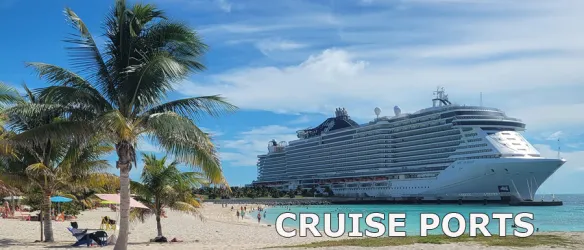

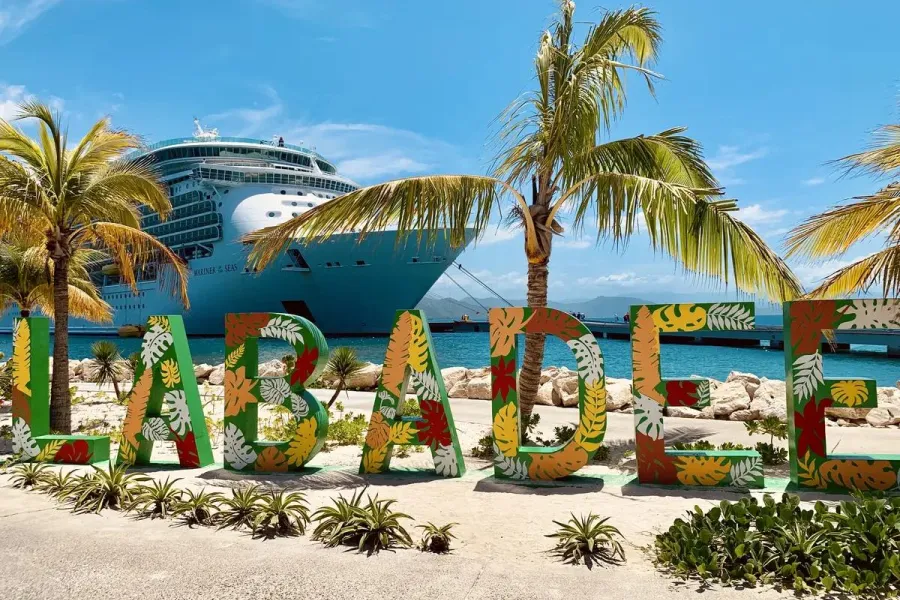
Royal Caribbean has extended its pause on visits to Labadee, its private destination in Haiti, canceling scheduled calls through December 2026 as the country’s security crisis continues to worsen.
A company spokesperson said the cruise line made the decision “out of an abundance of caution,” citing ongoing concerns tied to the situation in and around Port-au-Prince. Before the latest move, Royal Caribbean had already removed Labadee from itineraries through April 2026. The extended cancellation means Royal Caribbean ships will have gone well over a year without a planned stop at Labadee — the last scheduled visit was in April 2025, following earlier disruptions in 2024.
Labadee, marketed as a private beach experience operated by Royal Caribbean, has long been positioned as a controlled, resort-style stop where guests can spend the day ashore without venturing into the broader country. But the cruise line has repeatedly pointed to safety and operational risk in its decisions to skip the destination, telling guests in itinerary update emails that it is “monitoring the evolving situation” and adjusting plans accordingly.
Itineraries changed, ports replaced
Travel advisors were provided with updated port lists for affected sailings, with many itineraries swapping Labadee for alternatives or additional time at sea. In one itinerary notice sent to guests booked on Star of the Seas for a May 3, 2026 sailing, the cruise line said the ship would replace Labadee with a sea day. The same update also replaced a planned visit to San Juan, Puerto Rico, with a call in Philipsburg, St. Maarten (8 a.m. to 5 p.m.), and adjusted port times in Charlotte Amalie, St. Thomas to 8 a.m. to 5 p.m. The message acknowledged that some guests would welcome the changes while others would be disappointed, adding that safety remains the company’s top priority.
Haiti remains under highest U.S. travel warning
Haiti has been under a state of emergency since March 2024, when a surge in gang violence fueled widespread unrest and destabilized daily life, particularly in and around the capital. The U.S. State Department currently lists Haiti at Level 4: Do Not Travel, its highest advisory level, warning Americans not to visit the country for any reason and citing risks including armed crime, robbery, carjackings, kidnappings, and sexual assault.
U.S. maritime authorities have also flagged concerns about security conditions in Haitian ports. Until those concerns are addressed, officials have advised mariners and passengers traveling through Haiti to exercise caution.
Crisis deepens amid gang control and humanitarian strain
Haiti’s instability has intensified over the past several years, accelerating after the 2021 assassination of President Jovenel Moïse, which deepened political turmoil and created a power vacuum. Armed groups have since expanded control over large parts of Port-au-Prince and pushed outward into other regions, worsening a humanitarian emergency marked by displacement, hunger, and violence.
International efforts to stabilize Haiti have faced repeated setbacks, with past missions criticized as under-resourced. A new intervention effort is being discussed for 2026, but no clear timetable has emerged that would guarantee a near-term improvement in conditions.
For now, Royal Caribbean appears to be planning conservatively — reworking itineraries and removing Labadee well into 2026 — signaling that the cruise line does not expect a quick resolution to the situation on the ground.